
TV Mounting Works Anaheim: TV Mounting in Mid-Century Tract Homes in Anaheim
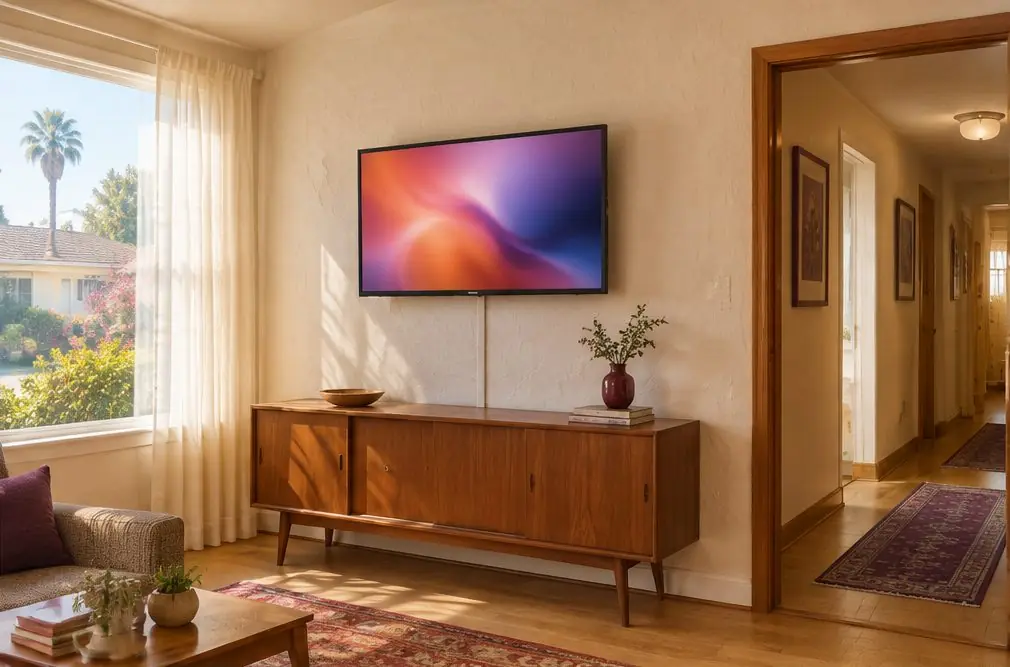
TV Mounting Works Anaheim covers TV mounting in the postwar tract houses that fill West, North and South Anaheim — compact single-story homes built in the 1950s and 1960s with plaster walls, picture windows and original outlets — where a local installer drills slowly, fastens into the studs behind the plaster and works around the wiring the house already has.
Bookings aren't open yet. Leave your name and number; your message is recorded, and you'll get one message when a local installer is available.
 Illustration
What a 1950s tract wall is made of
| Layer, outside to inside | What it is | What it means for drilling |
|---|---|---|
| Paint and finish coat | Hard, thin plaster skin | Chips if drilled fast with a dull bit |
| Plaster body | Thick plaster pressed into the lath | Holds poorly on its own |
| Lath | Narrow wood strips or metal mesh nailed across the studs | Hides the studs from many stud finders |
| Studs | Solid lumber, often with slight spacing variations | The only thing the mount should rely on |
Finding studs behind plaster
Magnetic finders pick up the lath nails, a few small test holes behind the plate's footprint confirm the stud edges, and the outlet boxes, usually fixed to a stud, give a starting line. Postwar framing is mostly regular, but remodels, doorways and added windows break the pattern, so each stud is confirmed before the plate is marked.
What the numbers show
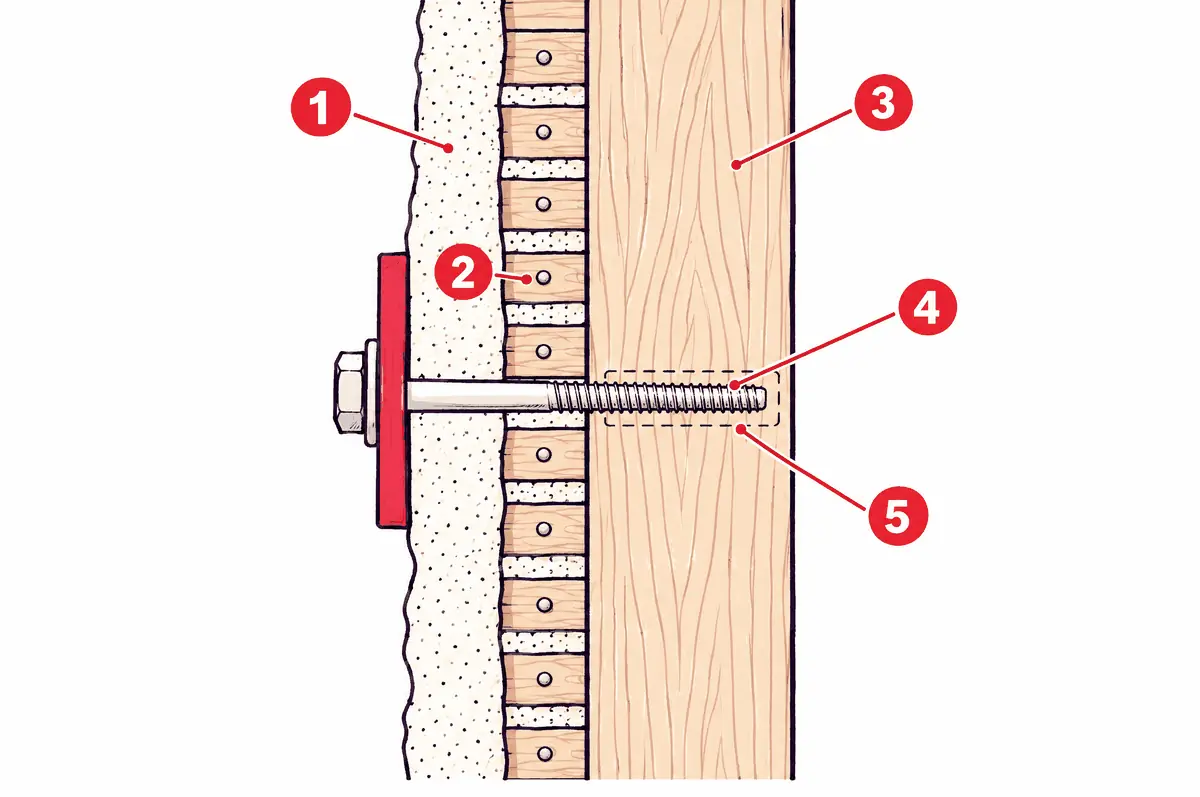
- Plaster coat The hard plaster layer is thick and brittle and only has to stay in place.
- Lath strips Narrow wood strips nailed across the studs hold the plaster and hide the framing.
- The stud behind The solid stud behind the lath is the only fixing point.
- Longer lag bolt The bolt is long enough to pass through the plaster and lath and bite deep into the stud.
- Pilot hole A pilot hole is drilled slowly first, so the plaster does not crack.
Drilling plaster without cracking it
An installer works plaster in a particular order:
- A carbide-tipped bit goes through the hard skin; a wood bit takes over once the stud is reached.
- The drill runs slowly with the hammer function off, so the plaster keys behind the lath stay intact.
- Pilot holes come first and the bolts are driven by hand or at low torque.
- Probe holes are filled with plaster patch, which shrinks less than plain spackle.
Old plaster rewards patience: slow drilling is the difference between four clean holes and a cracked wall.
Older outlets and where the cord goes
Many mid-century houses still have their first outlets, some with two slots and no ground. A TV and its devices plug into whatever outlet is already near the wall, behind a surge strip, and the mount does not change that.
Cables are fished in a clean stud bay where the plaster allows it, or run in a slim paintable raceway down to the console, which also leaves nothing to patch in a wall that is expensive to open.
TV Mounting in 1950s–60s Tract Homes — common questions
How much more does a plaster wall cost?
About $25–$45 on top of the base range in 2026, so roughly $124–$184 for a 32–49 inch TV on plaster over lath.
Can an old plaster wall hold a large TV?
Yes, when the mount is fastened into the studs behind the plaster with bolts long enough to reach solid wood. The plaster only has to stay in place; it carries no load.
Availability & price range
TV Mounting in 1950s–60s Tract Homes: check availability and price range
Bookings aren't open yet — answer a few quick questions about the TV and the wall and get a typical Anaheim price range right here. Typical Anaheim prices for one TV, labor only unless an option says otherwise. This is a market estimate, not a quote.